The Costs of Generating Electricity 2025 Report has arrived
Issued this fall, The Costs of Generating Electricity 2025, the Nuclear Energy Agency’s (NEA) tenth edition and its first produced with the Electric Power Research Institute (EPRI), compares plant-level costs for 23 technologies across 21 NEA member countries. A key finding is that “new electricity generation is becoming increasingly low carbon and more diversified, but also relatively expensive”, with most countries reporting a Levelized Cost of Electricity (LCOE) of US$100 / MWh or more for most generation options. Only long-term operation (LTO) of existing nuclear plants, hydroelectricity where available and, if their variability and related system-level costs are disregarded, onshore wind and solar PV come in at lower cost.
For decades, previous editions of this report entitled “Projected Costs of Electricity” produced by the NEA with the International Energy Agency (IEA) have been an essential resource on global electricity costs. The last version, issued in 2020, was the ninth in the series. We have been using charts and data from these reports in our studies and presentations over the years as a reliable independent assessment of the costs of electricity for a full range of generation options. However, with the electricity generating landscape evolving rapidly since 2020, its content has become dated, and we have been eagerly waiting for its next iteration. Well, the wait is over.
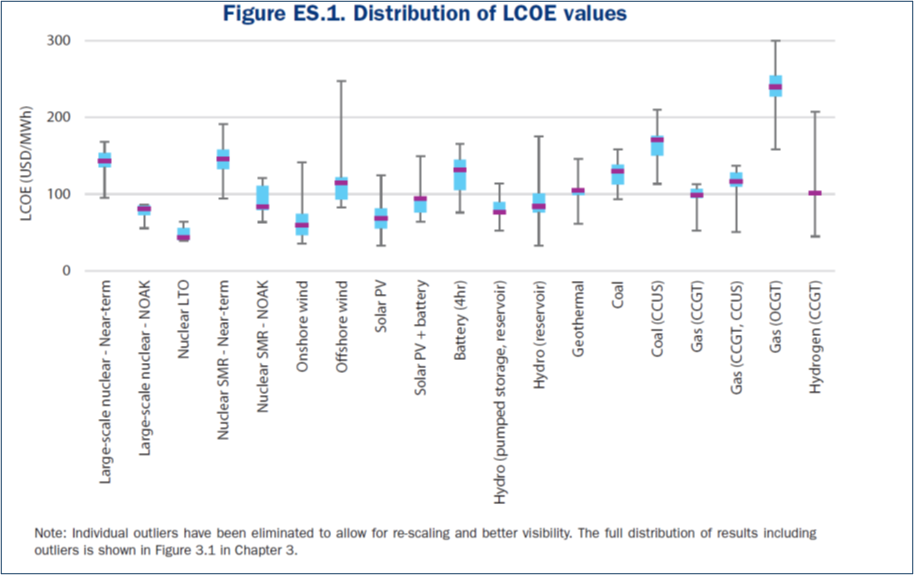
Once again, the report shows there is no lower cost generating option than extending the life of the existing nuclear fleet. LTO has the lowest median LCOE at US$44 / MWh within a range of US$39 / MWh to $64 / MWh (well below US$100 / MWh). For the first time in this edition, new nuclear costs are assessed for large reactors and SMRs for both near-term and nth-of-a-kind (NOAK) projects. Moving from early plants to NOAK projects could nearly halve costs, making nuclear highly competitive, with median costs of US$81 / MWh for large reactors and US$84 / MWh for SMRs. The report notes that achieving these NOAK costs will require standardized designs, continuous construction, a mature supply chain and sustained policy support. The data also illustrates that costs vary widely across countries, highlighting the sensitivity to location.
And while nuclear has the potential for significant improvements in costs going forward, renewables seem to have their cost reductions mostly behind them with wind and solar PV costs having stabilized when compared to past editions of the report.
This edition which for the first time was co-authored by EPRI, significantly changes how the data was collected. The 2020 and earlier editions were joint IEA/NEA reports based on country submissions from both OECD and non-OECD countries (24 in 2020). The 2025 edition covers 21 NEA member countries and “presents a fundamental change in sourcing, vetting and validating the underlying cost data”. Countries validated templates pre-filled from EPRI’s Generation Technology Options 2024 database, adjusted with locational factors from the 2010, 2015 and 2020 editions, instead of completing blank questionnaires.
And finally, when it comes to LCOE as a metric, the report concludes it remains useful because plant-level costs constitute a substantial part of system-level costs and LCOE remains uniquely transparent, comparable and intuitive. However, it also notes it provides only a partial view of electricity generating costs, as it does not reflect the value of electricity to the system at the time and location at which it is produced which is of critical importance especially when it comes to intermittent variable renewables. Therefore system-cost analysis remains an important addition to any LCOE analysis.
As usual, we are enthusiastic to see this report continuing its legacy of providing a valuable global reference for electricity generation costs while also demonstrating that nuclear energy indeed has the potential for long term competitiveness. We will reference it often. But always remember its purpose it to inform, not replace, the local system specific analysis needed to make sound investment and policy decisions.