The Commitment to Tripling Nuclear by 2050 continues to grow.
Two years after 25 countries signed the Declaration to Triple Nuclear Energy by 2050 at COP28 in Dubai, the momentum continues to build. This number grew to 31 at COP29 in Baku last year and now, at COP30 in Belem, Rwanda and Senegal became the 32nd and 33rd countries to sign, demonstrating Africa’s growing commitment to nuclear energy for economic development and energy security. Support is also growing with new signatories to the respective pledges by industry, major energy users and financial institutions.
Nuclear Energy Outlook to 2050
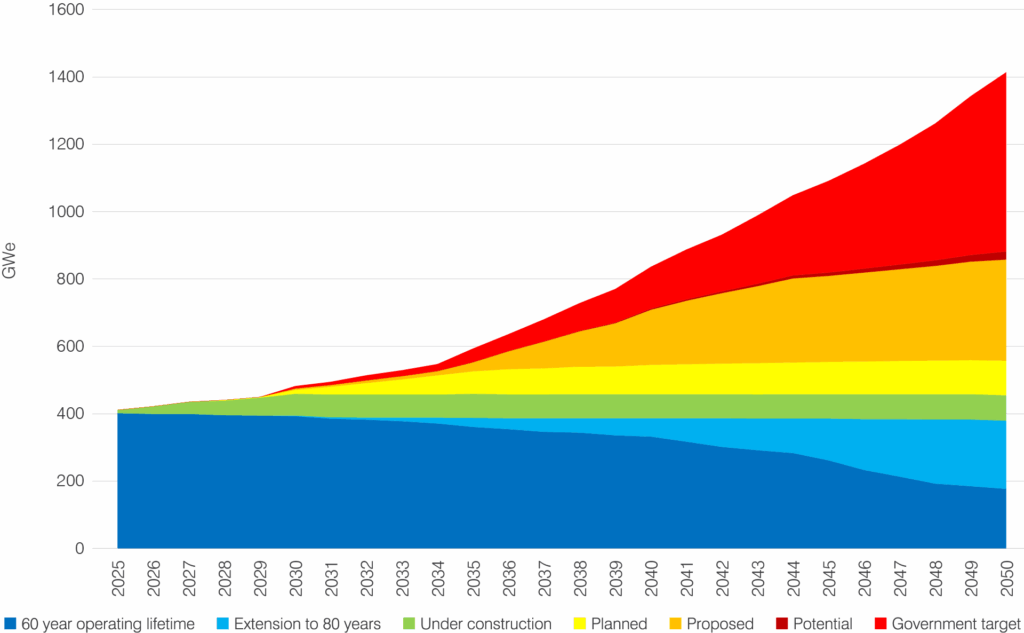
Source: WNA World Nuclear Outlook – preview 2025
Governments around the world are working to convert this pledge to policy. The WNA’s preview of its new World Nuclear Outlook Report 2025 shows that national targets already total 1,363 GWe by 2050—exceeding the 1,200 GWe tripling goal. With 50 countries planning nuclear capacity and existing reactors extended to 80 years, global capacity could reach 1,428 GWe by 2050.
Earlier in November, the International Energy Agency released its 2025 World Energy Outlook (WEO), considered an essential source of global energy analysis and projections. The report notes that given the geopolitical issues impacting the world’s energy supply and demand, the world remains thirsty for energy. And to satiate this thirst, the “world moves firmly into the Age of Electricity” with electricity demand growing much faster than overall energy use in all scenarios mostly being met with explosive growth in renewable energy, primarily solar power.
In the WEO Net Zero Emissions scenario, solar PV capacity expands from 2,164 GW in 2024 to 24,021 GW by 2050 – an incredible eleven-fold increase, an almost 10% compound annual growth rate. But while overwhelmingly positive on solar expansion, the IEA does acknowledge the mounting challenges this explosive growth brings. Rising curtailment levels in China, Germany, Brazil, Chile, and the UK signal grid flexibility gaps, while negative pricing hours have surged across multiple countries during peak solar generation. The agency emphasizes that dispatchable capacity and long-duration storage will be increasingly essential as variable renewable energy’s share of generation nearly doubles to 27% by 2030. Recent events in Northern Europe – periods of very low wind and solar output – underscore a critical reality: as renewables expand, reliable dispatchable power sources become more, not less, important for grid stability and energy security.
And to meet this growing need for reliable dispatchable power, the WEO 2025 states that “a common element across its scenarios is the revival of fortunes for nuclear energy,” explicitly acknowledging the tripling target. Yet the agency’s bias shows through – its section on tripling nuclear begins by cataloging challenges: “Several prominent nuclear energy projects in the United States and Europe face project delays and cost overruns, and the industry is still grappling with various public concerns, notably about long-term waste disposal challenges.” Only then does it add: “Yet momentum for nuclear power is building, driven by concerns about rising CO2 emissions or energy security, or both.“
The numbers tell a compelling story. The IEA’s WEO 2025 further validates nuclear’s revival, noting that after more than two decades of stagnation, global nuclear capacity is set to increase by at least one-third by 2035. Nuclear generation hit an all-time high of 2,667 TWh in 2024, with more than 70 GW of new capacity under construction – one of the highest levels in 30 years.
Most significantly, the IEA’s own projections for nuclear in its Net Zero Emissions scenario have strengthened with each successive report. The 2023 WEO projected 916 GW by 2050, the 2024 WEO increased this to 1,017 GW, and now the 2025 WEO reaches 1,079 GW—an 18% increase over just two years. This represents an increase of 2.6 times from today’s 420 GW and maintains nuclear’s 9% share of global electricity generation as total electricity demand soars. This upward trajectory in the IEA’s projections simply illustrates what grid operators already know: nearly all dispatchable sources of electricity must increase to balance intermittent renewables.
The convergence of support for scaling nuclear energy from nations, industries, and financial institutions is unprecedented. Even organizations long focused on renewable energy growth are acknowledging that nuclear power is essential to achieving net zero while maintaining energy security and grid stability. The ambition exists. Now comes the hard part – execution – scaling supply chains, securing financing, and moving with the speed this moment demands. Based on recent momentum, there is every reason for optimism.